
Montgomery County Bench Warrants Explained
Every Montgomery County bench warrant grows out of a case already open in Iowa District Court. That is where the paper starts. Iowa Rule of Criminal Procedure 2.7(4) lets a judge issue one when someone released from custody skips a proceeding that required personal attendance. The court can also forfeit bail. A missed date, an alleged release violation, contempt, and a disobeyed order can each land on a Montgomery County docket as different entries. So check the docket, because each kind of entry points to a different next step. Money alone tells you little, since an unpaid balance does not prove a bench warrant exists. A citation failure to appear can instead bring a simple-misdemeanor charge and an arrest warrant under Iowa Code section 805.5. The current order controls, not a guess built on debt. Debt, in short, is not proof.
Montgomery Warrants Start in District Court
Montgomery County runs one trial court. Iowa abolished its municipal, mayor, and justice courts through the 1973 Unified Trial Court Act. Everything now sits in Iowa District Court. A Red Oak traffic matter or simple-misdemeanor case stays there even when city police began it. Judicial magistrates handle scheduled violations, simple misdemeanors, municipal infractions, and other assigned matters. District associate judges and district judges hear the broader classes assigned them.
Local point: Red Oak Police does not operate a separate city bench-warrant court; the Montgomery County Clerk keeps the district-court docket.
Deputies and city police can serve a Montgomery County warrant, but only the issuing court can recall it.
How Montgomery County Bench Warrants Are Issued
A judge reviews the missed obligation first. The assigned judge or magistrate then enters the order. From there it travels. A Montgomery County warrant can appear as an event on the court docket and pass through law-enforcement systems. Iowa's IOWA System connects more than 450 criminal-justice agencies and links with NCIC, but only authorized agencies may use it. No public name search lives there. The warrant stays open until it is executed or until the issuing court recalls or quashes it. A recall withdraws it. To quash means to set it aside through a court order. Montgomery County has no automatic grace period, mailed-warning policy, or same-day recall calendar. Never borrow those options from another county.
Montgomery County Clerk-First Search
Begin with Iowa Courts Online. Search by exact name or case ID and select Montgomery County when offered. Then note the case number, event, and date. A docket can identify a case yet still omit an unexecuted order or a confidential document.
- Call the Clerk at 712-623-4986 with the case number and exact name.
- Ask whether the warrant is active and who issued it.
- Ask whether an appearance, bond, payment, attorney filing, or motion is required.
- Call the Sheriff at 712-623-5107 for execution, custody, or service instructions.
- Use the county public-information route when a record is not available online.
Formal requests go to the office that keeps the record. The Auditor's Office at 712-623-5127 can route you. No bench-warrant roster exists. Montgomery County runs no 24-hour warrant line either.
Bench and Arrest Warrants Compared
Both papers authorize an arrest. Their starting points differ, though. A Montgomery County bench warrant usually answers conduct inside a case already before the court. An arrest warrant is different. Iowa Code chapter 804 bases it on a complaint or affidavit showing probable cause, and section 805.5 adds a wrinkle because willfully failing to appear on a citation can itself be an offense.
| Feature | Bench warrant | Arrest warrant |
|---|---|---|
| Starting event | Missed appearance or order issue | Probable-cause complaint or affidavit |
| Case setting | Usually an existing case | An alleged offense or FTA offense |
| Issuer | Assigned judge or magistrate | Authorized judge or magistrate |
| Next step | Appearance, recall, or quash | Execution, appearance, and release process |
The Clerk can classify the entry, and the Montgomery County arrest warrant search page covers probable cause in more depth.
Iowa FTA Terms in Montgomery County
You may hear "capias pro fine" in other states. Iowa does not use that label for Montgomery County matters. Iowa sources say bench warrant for a court-side missed appearance and arrest warrant for the failure-to-appear offense in section 805.5. The right words help the Clerk find the right event.
- FTA
- A failure to attend a required court appearance.
- Recall
- A court action withdrawing its warrant.
- Quash
- A court order setting the warrant aside.
- Bail forfeiture
- Loss of bail when ordered after a missed necessary appearance.
When you call, ask about a bench warrant, an FTA arrest warrant, and the current instruction in Montgomery County. The labels are not interchangeable.
Resolving a Montgomery County Bench Warrant
Confirm before any unplanned visit. Call the Clerk of Court first. Montgomery County publishes no walk-in surrender program, warrant calendar, guaranteed after-hours intake, or local amnesty form. Ask whether the judge requires a new date, initial appearance, bond, payment, written motion, or attorney involvement.
- Save the case ID and relevant docket entry.
- Confirm status and the issuing court with the Clerk.
- Ask what papers, payment proof, or motion the court accepts.
- Confirm the place and time before appearing.
- Keep the order, receipt, and new court date.
Do not ignore the order: an open bench warrant can lead to arrest, while payment alone may not recall it.
A lawyer can move to recall or quash. In Montgomery County, a defendant who cannot afford counsel may request the court-appointed-attorney form from the Clerk, though eligibility and timing rest with the court.
Montgomery Bench Warrant Record Fields
A court file can hold plenty. It may distinguish the warrant from the underlying case in Montgomery County. Visibility varies. Agency-only status may not appear online.
- Case ID
- The district-court identifier
- Required appearance
- The hearing that required attendance
- Order date
- The date of judicial action
- Issuer
- The judge or judicial magistrate
- Bond event
- Any public bail endorsement or forfeiture
- Return or recall
- Execution, return, quash, or withdrawal entry
Juvenile records in Montgomery County follow separate confidentiality rules under Iowa Code chapter 232. A blank search proves nothing.
Finding the Montgomery County Court
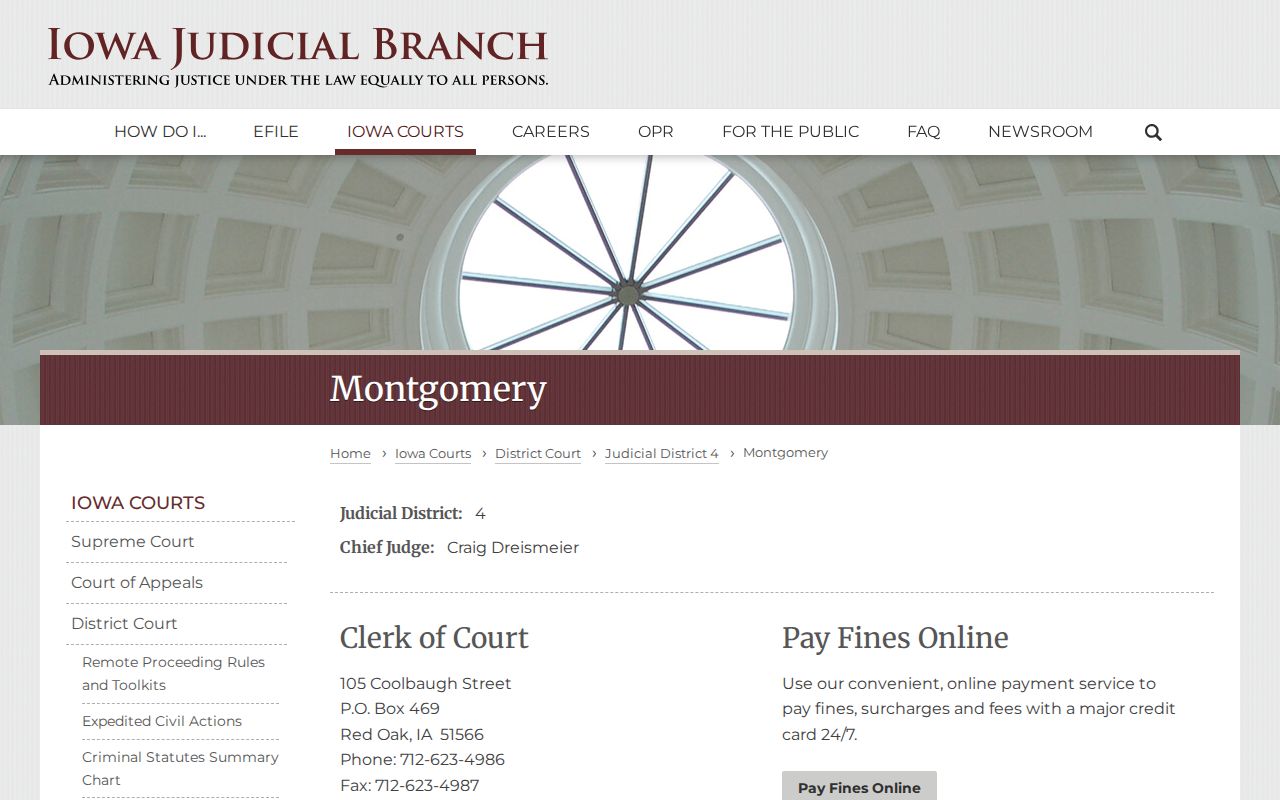
The Clerk of Court sits at 105 E Coolbaugh Street in Red Oak. Call 712-623-4986. The official county court page shows the South entrance, street parking, and the security setting for the courthouse. Getting in is one thing. Those details promise neither a same-day recall nor a walk-in result.
The Sheriff sits at 106 W Coolbaugh Street. Office hours run 7:00 a.m. to 4:00 p.m. on weekdays, and its role in Montgomery County is service and custody, not recall.
Montgomery County Bond Questions
Bond rules in Montgomery County come from Iowa Code sections 804.3 and 804.21, which cover bail endorsements, initial appearances, release, and how bond is scheduled. The county posts no warrant bond table. There is no published list of accepted payments, surety roster, personal-recognizance criteria, refund rule, or after-hours bond window either. The court's order controls whatever the paperwork leaves open. So ask the clerk whether bond has been set, where you can post it, which payment forms work, and whether an appearance is still required. One caution: paying a citation can count as a plea, and a payment screen does not recall the warrant.
Verify Montgomery Warrant Payment Demands
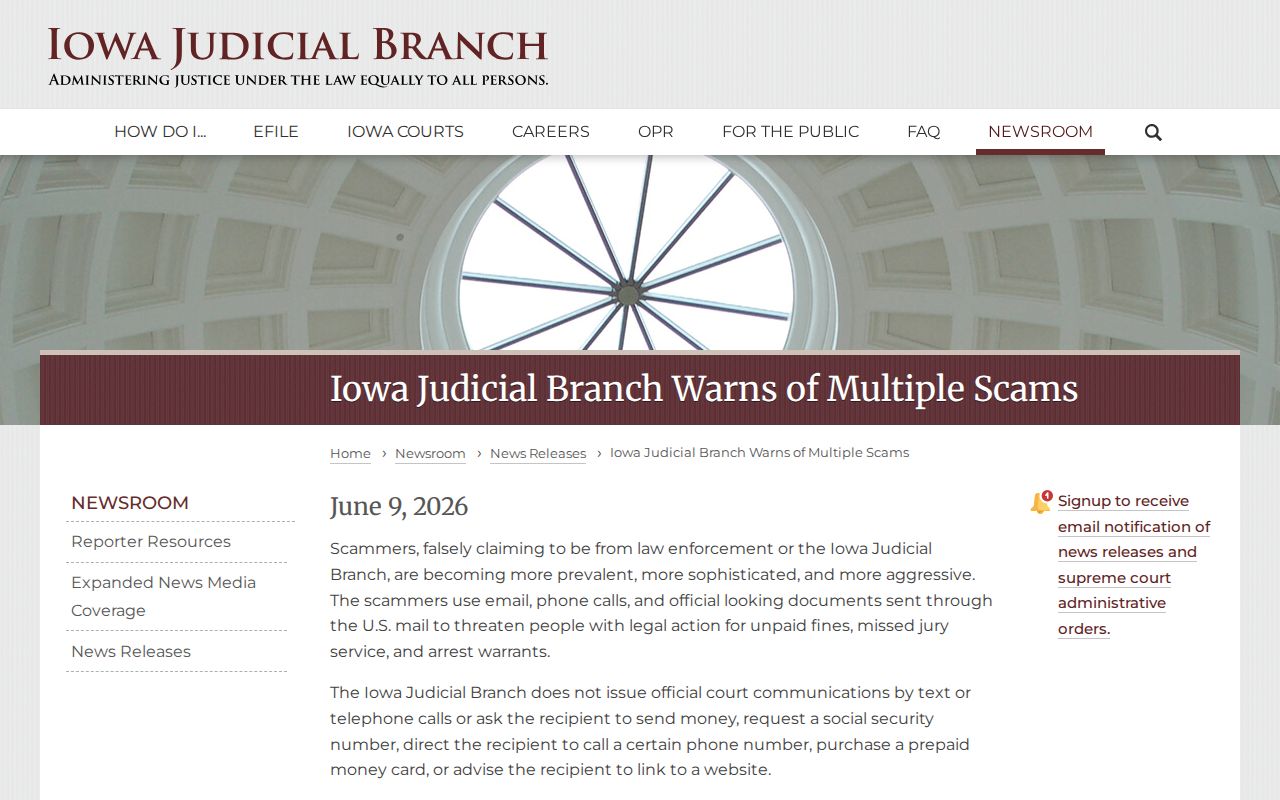
Scammers have been posing as courts and police in calls to Iowans, and the Iowa Judicial Branch issued a June 9, 2026 warning about it. Real court communications never demand a Social Security number, prepaid card, cryptocurrency, or instant phone payment to stop an arrest. Officers do not collect fines. Montgomery County residents can verify any supposed warrant payment demand through Iowa Courts Online, the Clerk, or the Sheriff.
Check any Montgomery County payment demand through Iowa Courts Online, the Clerk, or the Sheriff's published number. A threat alone proves nothing.