
Checking for a Warrant in Montgomery County
Montgomery County publishes no sheriff name-search page, so the practical first stop is Iowa Courts Online. That portal opens public Iowa District Court case information to anyone. Search your own case by exact legal name or case number. Read the docket for a warrant entry or a failure-to-appear note. Then ask an official office whether the order still stands, because a docket line alone may lag behind events. Before you call, gather the legal name, spelling variants, an approximate filing or court date, and a case or citation number if you have one. Give a birth date only when an office asks for it to sort out similar names. If a warrant does appear in Montgomery County records, a lawyer can help you plan the safest response.
- Search Trial Court records by name or case ID.
- Open the case detail and read dated docket entries, not only the caption.
- Call the Montgomery County Clerk of Court to confirm the order and appearance instruction.
- Call the Sheriff about agency-side service, custody, and bond routing.
- Speak with counsel before surrender, bond, or a motion to recall or quash.
Montgomery County Has No One-Stop Warrant List
Iowa Courts Online is a case portal, not a statewide warrant database. The IOWA System links more than 450 criminal-justice agencies to state and national files, but the public cannot search it. A fresh or restricted order can sit outside public view entirely, and a court result says nothing about live service status. That gap makes confirmation the heart of any Montgomery County warrant check. A person might spot a docket entry online, hear the court-side story from the Clerk, and still need the Sheriff to say whether the office ever received the order for service. Each channel answers only its own question. Stretch any one of them further and you get a wrong answer, so use them in sequence rather than in place of each other.
Quick answer: A name not found online is not proof that no Montgomery County warrant exists; confirm with the Clerk and Sheriff.
Montgomery County Warrant Types
Iowa works with several kinds of process, and the reason behind each order shapes the next step. A complaint-based arrest warrant is not the same as a bench warrant tied to a missed appearance. A search warrant authorizes a search, not a public self-check. Iowa sources use arrest warrant, bench warrant, and failure-to-appear language; the Texas phrase "capias pro fine" does not appear in Montgomery County paperwork.
| Type | How it arises | Issuer |
|---|---|---|
| Arrest warrant | A complaint and facts establish probable cause. | District Court judge or magistrate |
| Bench warrant | A required appearance is missed or an order is not followed. | The judge handling the case |
| FTA arrest warrant | Failure to appear on a citation can form a simple-misdemeanor process. | Iowa District Court |
| Search warrant | Probable cause supports a search of described property. | Judge or magistrate |
Civil contempt and child-support matters can carry coercive orders, yet not every civil attachment counts as a criminal arrest warrant. Juvenile and family records face special access limits too. Ask the Clerk what kind of order actually sits on the Montgomery County docket.
Two Coolbaugh Offices Answer Different Questions
Two offices in Red Oak answer different questions, and picking the right one first saves confusion. The Clerk of Court at 105 E Coolbaugh Street keeps the Iowa District Court case file. The Sheriff at 106 W Coolbaugh Street handles service and custody. Treat a docket answer from one as a custody instruction from the other and you will go wrong. So split your questions. Ask the Clerk whether the docket shows an outstanding order, who issued it, and what appearance or filing instruction is current. Ask the Sheriff whether agency-side status can be confirmed, and where bond or a planned surrender fits. Neither office in Montgomery County gives legal advice, and neither will build a strategy for you.
Inside a Montgomery County Warrant Record
A public Montgomery County case record usually reveals an order through docket text, not a tidy warrant card. Read identifiers and dates together, since context gives them meaning. The underlying case number matters more than any guessed warrant number, because the portal and the Clerk can use it to pull related filings. Some fields may be missing or restricted.
| Case identifier | The Iowa District Court number connecting the docket, charge, filings, and orders. |
|---|---|
| Person | The case name, checked carefully where names are common. |
| Authority | The alleged offense, citation, or basis associated with the order. |
| Issuing court | Iowa District Court for Montgomery County and the judicial officer when shown. |
| Bond terms | Only current official terms control; no fixed county amount was found. |
| Status events | Issued, served, returned, recalled, quashed, released, or initial appearance. |
Read a Montgomery County Docket as a Timeline
A caption only tells you a case exists. The docket gives the real timeline: an appearance setting, a failure to appear, the issuance order, a return, an arrest or initial appearance, and a recall or quash entry can each change the answer. Always read the newest entry alongside the order it addresses. Words like "bond," "released," and "payment" do not by themselves prove the warrant ended, so ask the Clerk to identify the controlling event. When public detail runs thin, Iowa guidance points to the county clerk or a courthouse public terminal. The records office supplies documents but does not run open-ended searches for a requester.
Issuing and Serving Warrants in Montgomery County
Iowa runs one unified District Court. District judges, associate judges, and judicial magistrates all perform assigned warrant functions. Municipal, mayor, justice, and police courts were consolidated in 1973, so a Red Oak traffic or ordinance case creates no separate municipal-court warrant system in Montgomery County.
Montgomery County Clerk of Court
105 E Coolbaugh Street, PO Box 469
Red Oak, IA 51566
712-623-4986
The Montgomery County Sheriff lists weekday office hours of 7:00 a.m. to 4:00 p.m. There is no dedicated warrant phone line, no public roster, and no after-hours bond desk. Use 911 only for a true emergency.
Montgomery County Service Changes at Red Oak
Red Oak runs its own police department inside city limits. The Sheriff covers the rest of Montgomery County and holds documented 28E coverage for Coburg, Elliott, Grant, Stanton, and Villisca. That map decides which agency knows about an incident or arrest, though the warrant record stays with the Clerk either way. Match your call to the question. A Red Oak police matter goes to the non-emergency line at 712-623-6500. A court order question goes to the Clerk. Service or custody questions go to the Sheriff. The 911 center dispatches for both the county and Red Oak, but emergency dispatch is not a warrant-status service. The official dispatch page lays out this shared footprint.
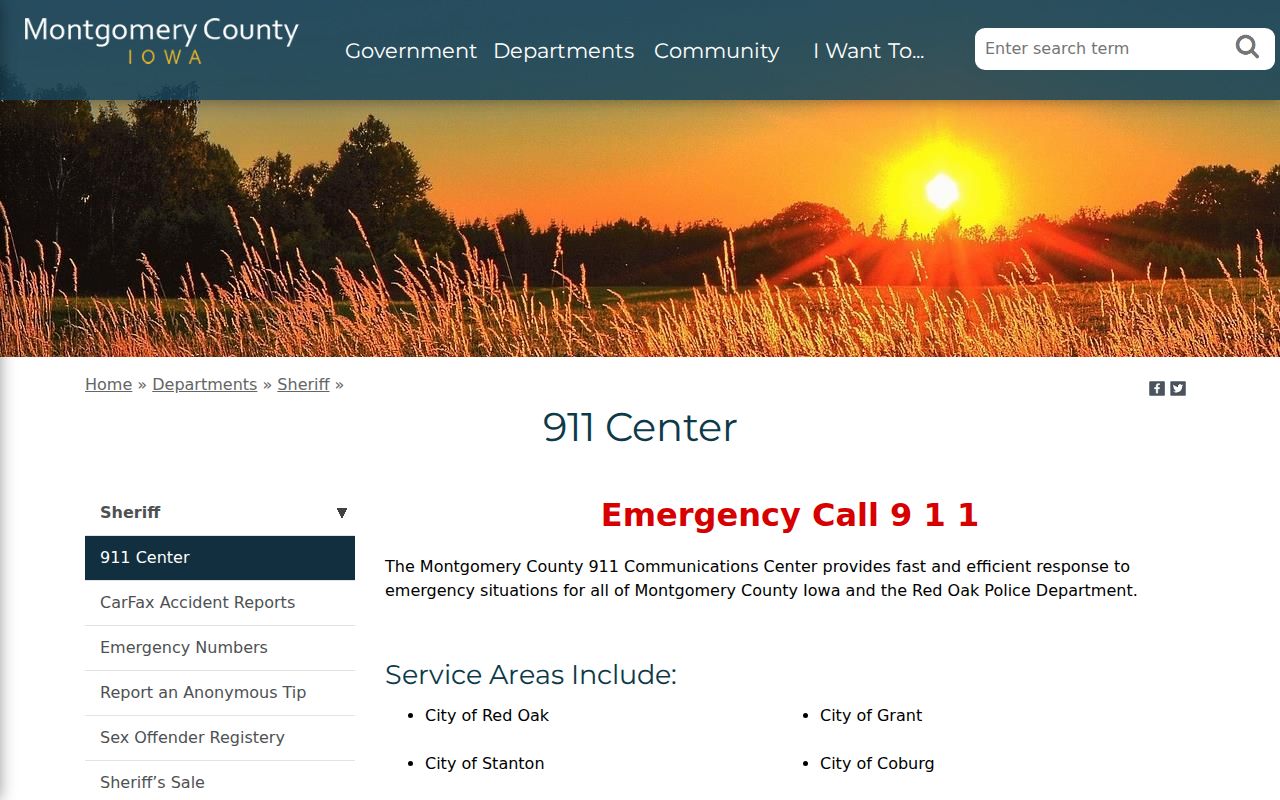
The service map points you to the likely police contact, while the Montgomery County warrant record itself stays with the Clerk.
If You Have a Warrant in Montgomery County
Before anyone drives to the courthouse or jail on a hunch, get the facts. Call the Clerk first. Ask whether a hearing, initial appearance, bond condition, payment step, or motion sits on the docket for your case in Montgomery County. Then ask the Sheriff where surrender and bond questions belong on the agency side. No local office here promises walk-in recall or same-day resolution, so plan around that reality. A lawyer earns their fee at this stage. Counsel can reach the issuing court, pursue the proper recall or quash procedure, map out a voluntary appearance, and explain when appointed counsel may be available. Remember that only the court can withdraw its own order; paying debt, visiting an office, or posting bond alone does not close the underlying case.
Important: Confirm current instructions and speak with counsel before appearing; an active warrant can result in arrest.
Montgomery County Court Debt Is a Separate Check
Traffic citations and court debt follow a different track than warrant status. Iowa's Pay a Fine service handles payments for Montgomery County and the rest of the state. To use it, you need a case type, county, and a case number or name. Expect a citation to take 10 to 14 days before it posts, longer near weekends and holidays. The online system takes major credit cards around the clock. Be careful, though. Payment can count as a guilty plea where the court warns that it does, and delinquent debt can shift to county-attorney or Central Collections Unit handling. A receipt proves you paid; it does not recall a bench or FTA warrant. Check the debt and the warrant event separately, then read the official instructions, which walk through the state process.

The payment route supports a known case, not a warrant-clearance guarantee.
Montgomery County Warrant Records and Public Access
Public access here rests on two foundations. Iowa Code chapter 22 governs records held by government, while court records also answer to Judicial Branch rules and specific confidentiality laws. Montgomery County sends each requester to the department that actually holds the record. Unsure which office that is? The Auditor at 712-623-5127 serves as the county routing fallback.
Key rules:
Iowa Code chapter 22 supplies the public-record framework, subject to exemptions.
Unexecuted warrants and active-investigation material may be confidential.
Juvenile and child-related records may be restricted under Iowa Code chapter 232.
A complex request may need to be written and detailed enough to locate an existing record.
A Focused Montgomery County Records Request
Ask for a specific item, not a fishing expedition. Staff will not research every warrant for you. A workable request names the record type, date range, case number, issuing office, and preferred format. It might target one order, a docket entry, a return, or a dated sheriff record. Request a cost estimate before retrieval, review, redaction, copies, postage, or programming begins. Montgomery County publishes no warrant form, tracker, deadline, or fixed fee for this. Iowa guidance allows verbal or written court-record requests during office hours, though a complex request may need writing. If material gets withheld, ask which chapter 22 exemption or court rule applies. Public access does not mean every unexecuted or juvenile record must be disclosed. The Judicial Branch notes that offices do not perform research for requesters, and a request framed as all warrants may demand a compilation no one maintains. Narrow language gives staff a real chance to find the actual Montgomery County record you need. One gap remains: the county posts no current certified-copy charge, so confirm pricing and any local court-copy schedule directly with the office.
Montgomery County Scam Checks Before Payment
Scammers work the warrant angle hard, so verify before you pay anything. A June 2026 Iowa Judicial Branch warning spells out the tells. Courts will not demand money, Social Security numbers, prepaid cards, or Bitcoin by text or phone. Officers do not collect court fines. A caller who knows your name or a case detail is not thereby authentic. Hang up. Reach out yourself through the published Clerk number, the official portal, or the Judicial Branch at 515-348-4788 during business hours. Never send card data or identity documents to an unverified address. Treat the case number and claimed amount only as clues to verify, and type the official address yourself or follow a link from the Iowa Judicial Branch site. A genuine Montgomery County order can be checked through the court and sheriff chain. Already sent funds? Contact the payment provider and the appropriate law-enforcement agency, then ask the Clerk whether the actual Montgomery County case shows any balance or warrant event. Urgent threats never replace a court record.
Montgomery County Warrant Status Terms
Status words describe different moments and should be verified against the dated record.
- Issued
- The court authorized the warrant.
- Outstanding
- The order appears unresolved, subject to confirmation.
- Served
- An officer carried out the arrest command.
- Returned
- The agency reported action or non-service.
- Recalled or quashed
- The court withdrew or set aside the warrant.
- FTA
- Failure to appear for a required setting.
- Bond
- A release condition, not proof the case is over.
People say a warrant is active, but that word has no official weight. The safer question for Montgomery County is whether the issuing court still treats the warrant as outstanding, and whether the serving agency has current instructions.
Montgomery County Warrants by City
Montgomery County's cities line up by 2020 Census population. Red Oak runs its own police department. Villisca, Stanton, Elliott, and Grant rely on Sheriff coverage. In every city, court records route through Iowa District Court rather than a separate municipal court.